Multilingual Learners’ Exposure to Science and Language Inputs in Elementary School: ¿Qué sabemos?
While much of the research in education has understandably focused on Multilingual Learners (MLs) and their acquisition of English, there’s a growing recognition of the importance of science education for elementary MLs. Understanding the interaction between science and language inputs available to MLs in schools is crucial for enhancing their science learning experiences.
Drawing on nationally representative data from the Early Childhood Longitudinal Study of 2010-11, our study delves into the science and language inputs accessible to MLs in elementary schools. We used descriptive statistics to analyze these inputs, providing insights into the resources and opportunities available to multilingual learners (MLs). Interestingly, while science inputs seem to be fairly evenly distributed across classrooms serving both MLs and non-MLs, the distribution of language inputs varies significantly among ML subgroups, potentially impacting their engagement with science materials.
Our Findings
Our investigation into educational resources for Multilingual Learners (MLs) uncovers a mixed landscape. While science inputs appear relatively evenly distributed across MLs and non-MLs, disparities emerge in language support. MLs receiving formal English Language Learner (ELL) services benefit from more intensive language instruction, bilingual settings, and greater access to material resources like translated communication and books in non-English languages. However, these supports diminish as students progress through elementary school, highlighting concerns about the continuity of language support for MLs.
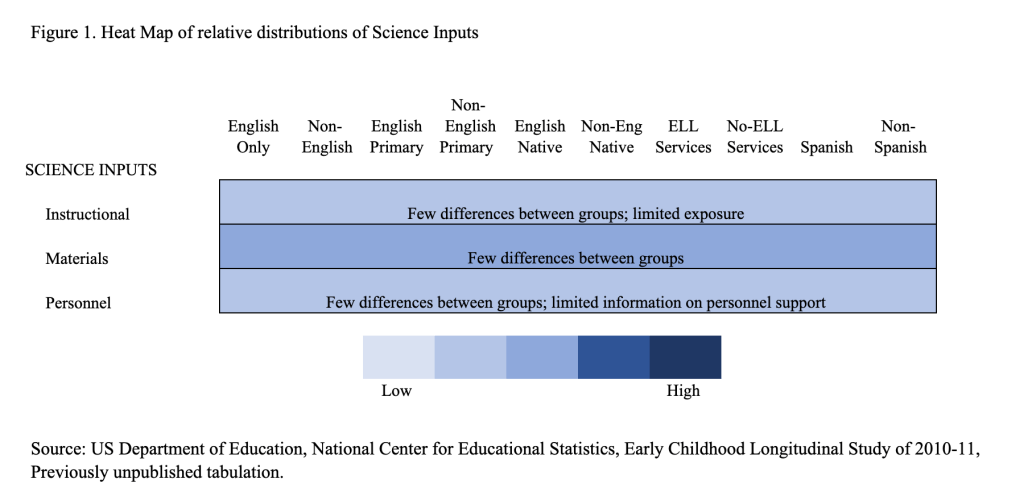
The heat map in Figure 1 provides an overview of science inputs across our MLs, non-MLs, and subgroups. Moreover, while science inputs seem generally consistent, there is room for improvement in providing comprehensive science education across all topics and skills. Efforts to enhance science education for MLs should be accompanied by strategies to address language barriers and ensure access to language resources, ultimately creating a more inclusive learning environment for all students.
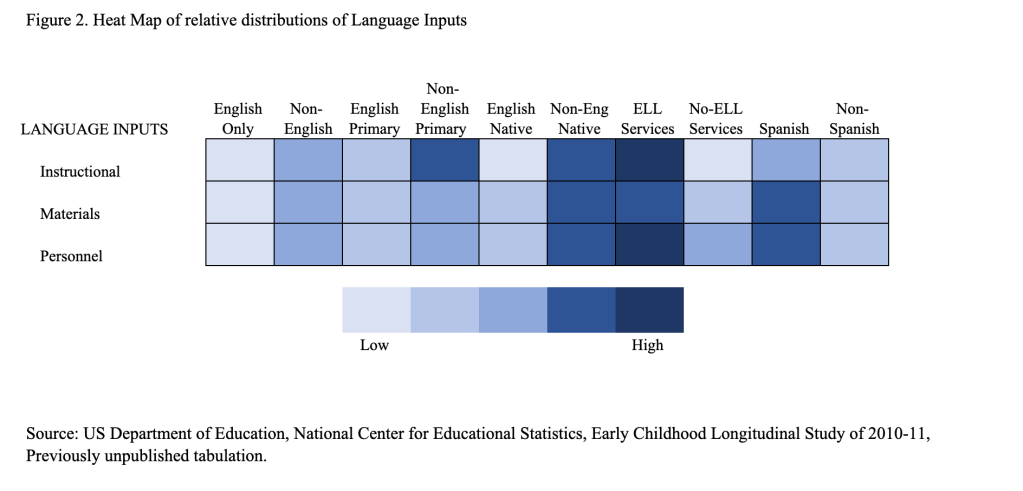
Similar to Figure 1, Figure 2 provides an overview of language inputs across our MLs, non-MLs, and subgroups. Examining the findings on language inputs, our research reveals a diverse landscape of access within ML students. Unlike the uniformity observed in science inputs, MLs exhibit varying distributions of language resources across different subgroups.
Our work points to the importance of considering science inputs alongside language inputs. While ML students may be in classrooms with similar access to science learning opportunities as non-MLs, their ability to access these resources and opportunities may be constrained by limitations in language inputs. For example, science textbooks are valuable but may have less impact if not available in a Multilingual Learner’s native language.
What’s Next?
By documenting these differences in science and language inputs, our study lays the groundwork for improving formal learning environments for MLs, particularly in the realm of science education. Addressing these discrepancies and ensuring fair access to both science and language resources can pave the way for more inclusive and effective educational experiences for MLs. As we strive to create learning environments that cater to the diverse needs of all students, understanding and addressing these nuances is essential for fostering academic success and empowerment among MLs in science and beyond.
Check out the Full Publication
 Factors in Multilingual Learners' Science Success