Reclassification and Multilingual Learners’ Science Achievement
This study adds to a growing body of scholarship that examines how reclassification impacts MLs’ academic outcomes. Using data from the nationally-representative Early Childhood Longitudinal Study of 2010-11 (ECLS-K:2011), we delve into the relationship between reclassification and MLs’ science achievement on a national scale. Furthermore, we explore how contextual factors, including family, school, and individual characteristics, influence this relationship through regression analyses with panel data.
Our Findings
Our findings indicate that while reclassification initially correlates with higher science test scores compared to students retaining their English Learner (EL) status, this association diminishes once controlling for other factors. Moreover, we uncover variation in science achievement among different subgroups of MLs following reclassification.
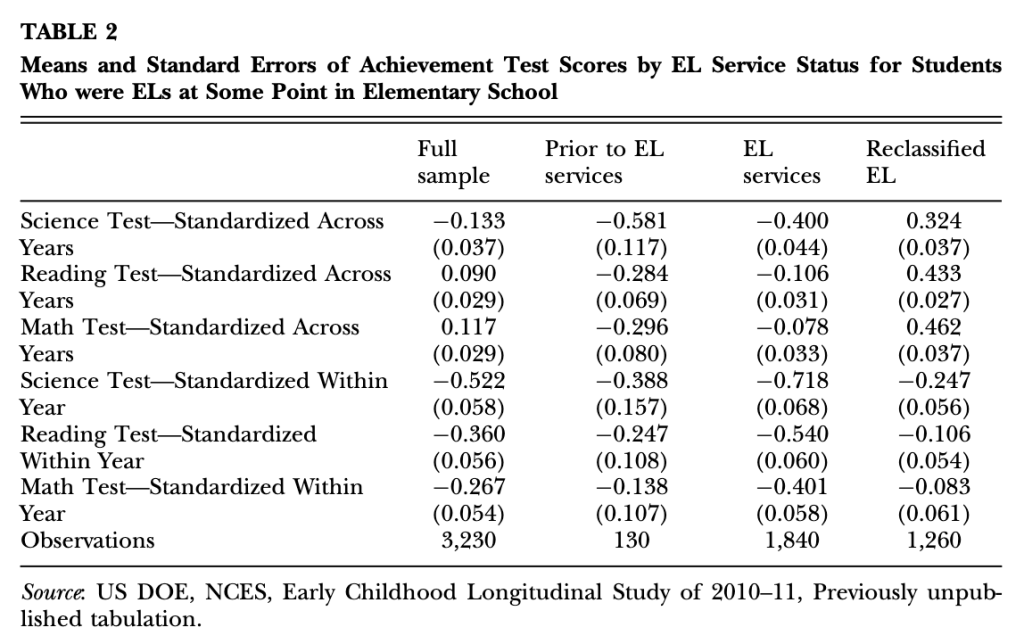
Examining the relationship between EL reclassification and science achievement, our study reveals nuanced findings. We found a significant decrease in the number of ELs as they advance through grades, accompanied by a notable improvement in academic performance across subjects. While initially associated with improved science scores, this relationship diminishes when accounting for prior academic performance and other factors.
As seen in the table above, in descriptive terms, the science, reading, and math test scores of reclassified ELs significantly surpassed those of ELs currently receiving services. This difference is likely attributable to two factors: first, reclassified ELs are typically identified for reclassification based on stronger academic performance, and second, reclassified students tend to be in higher-grade levels where test scores, standardized across the elementary years, are generally higher on average.
Subgroup analysis highlights varied outcomes, underscoring the complexity of reclassification’s impact on science learning. Ultimately, our findings emphasize the importance of timely reclassification decisions in supporting EL students’ academic progress.
What’s Next?
These results carry significant implications for the reclassification process and its impact on MLs’ academic achievement. By understanding the nuances of reclassification and its effects on science learning, we can better inform education policies and practices to support the diverse needs of MLs. By and large, ELs seem to be reclassified at the right moment–if their scores varied greatly after reclassification, we might surmise that they retained their EL status past the point of usefulness. Moving forward, our study calls for further research into reclassification, MLs, and academic achievement to continue refining strategies that promote educational opportunities for all students.
Check Out the Full Publication
 Factors in Multilingual Learners' Science Success